WHAT WE DO
Pool Repair in Austin, TX, Fast Diagnosis, Clean Fix
Equipment, pump, tile, plaster repair and leak detection. Fast diagnosis, clean fix, no guesswork.
Why Act Fast
Pool Problems Do Not Get Better on Their Own
A pump running wrong fails faster. A small leak at a fitting turns into a bigger repair once it has time to work at a seal or a slab. A chemical imbalance left unchecked shortens the life of the equipment around it.
The longer a problem sits, the more it costs. Most repair calls get an on-site inspection the same day or the next business day, so the actual failure point gets found and fixed before it turns into something bigger.
Services
What We Fix
- Pump repair and replacement
- Filter cleaning, repair, and replacement
- Tile repair and waterline tile replacement
- Plaster repair and spot patching
- Leak detection and repair
Certifications
Equipment Brands We Work On
The team is certified on Fluidra, Hayward, Jandy, Waterway, and Zodiac equipment, plus National Pool Tile, covering the large majority of what shows up across Austin-area pools.
- Fluidra
- Hayward
- Jandy
- Waterway
- Zodiac
- National Pool Tile
HOW IT WORKS
A Straight Path From Call to Clean Pool
No pressure, no sales pitch. Just a clear process from first call to finished work.
Step 1
Call or Text
Reach out and tell us what you need, maintenance, a repair, or something bigger. No pressure, no sales pitch.
Step 2
Free On-Site Inspection
Max comes out, looks at your pool, and gives you a straight answer. If it is a quick fix, he tells you. If it needs more, you get an honest estimate.
Step 3
Clear Plan
You get a straight answer on scope, timeline, and price before any work starts.
Free InspectionBefore any quote
Step 4
Service Starts
Once you are in, you are in. Consistent weekly service, clear communication, and a pool you actually want to swim in.
QUESTIONS
Frequently Asked Questions
Max Pools Austin provides weekly pool maintenance, repair, and boutique construction across the greater Austin, TX metro and the Texas Hill Country, including Austin, Westlake Hills, Bee Cave, Lakeway, Dripping Springs, Spicewood, Driftwood, Buda, and Round Rock. Because the client roster is kept intentionally small, Max personally services every route himself rather than dispatching a rotating crew across a wider territory. If your address is close to one of these communities but you are not sure whether it falls inside the current route, call or text and Max will tell you directly rather than leaving you guessing from a generic coverage map.
Pool Repair in Austin, TX: What Homeowners Should Know
A pool repair call almost always starts the same way: something that used to work fine suddenly does not. Here is a detailed look at how pool problems actually develop in the Austin area, what a proper repair diagnosis looks like, and what determines whether a repair is quick or involved.
Why Pool Problems Rarely Stay Small
Pool equipment fails in a fairly predictable pattern: a small issue creates added strain somewhere else in the system, and that added strain accelerates the next failure. A pump running with a partially clogged impeller works harder than it should, which raises its operating temperature, which shortens the life of its motor. A slow leak at a union fitting does not just waste water, given enough time it can erode the surrounding soil and undermine deck or coping above it.
Chemical imbalance follows the same pattern from a different angle. Water that sits too acidic for an extended stretch etches plaster and corrodes metal fittings; water that sits too basic or too hard deposits scale on tile lines, inside heaters, and on salt cell plates. Neither extreme causes a dramatic, obvious failure right away. Both quietly shorten the working life of everything the water touches until a component finally gives out.
This is the practical case for treating a small, easily-dismissed symptom, a pump running slightly louder than usual, a faint chemical smell, a pressure gauge reading a few PSI outside its normal range, as worth a look rather than something to monitor for a few more weeks. The cost difference between catching a developing issue early and discovering it after a full failure is rarely small.
The Most Common Pool Repairs Around Austin
Pump repair and replacement is the single most frequent repair call, since the pump is the piece of equipment doing the most continuous mechanical work in the entire system. Common failure points include a seized bearing, a failing capacitor, or a locked-up motor, and on newer variable-speed units, a fault in the control board itself rather than a purely mechanical failure.
Filter cleaning, repair, and replacement covers a wide range, from a cartridge filter that simply needs a proper cleaning cycle to a cracked filter tank that needs full replacement. A filter that is not doing its job shows up indirectly, as cloudier water or a pool that takes longer to clear after a chemical adjustment, rather than through an obvious visible failure at the equipment pad.
Tile and waterline tile replacement and plaster repair and spot patching address the pool shell itself rather than the equipment: cracked or missing tile at the waterline, etched or stained plaster, and small surface repairs that catch a developing problem before it spreads. Leak detection and repair rounds out the most common calls, since a leak can originate from the shell, the plumbing, or the equipment itself, and correctly isolating which one is the actual point of failure is most of the work in fixing it right the first time.
How a Proper Repair Diagnosis Actually Works
The single biggest difference between a repair done right and a repair that fails again in six months is whether the actual root cause got identified before anything was replaced. Swapping a failed part without understanding why it failed often just sets up the same failure again on a similar timeline, particularly with chemistry-driven damage like scale or corrosion, where a new component installed into unchanged water conditions scales or corrodes just as fast as the one it replaced.
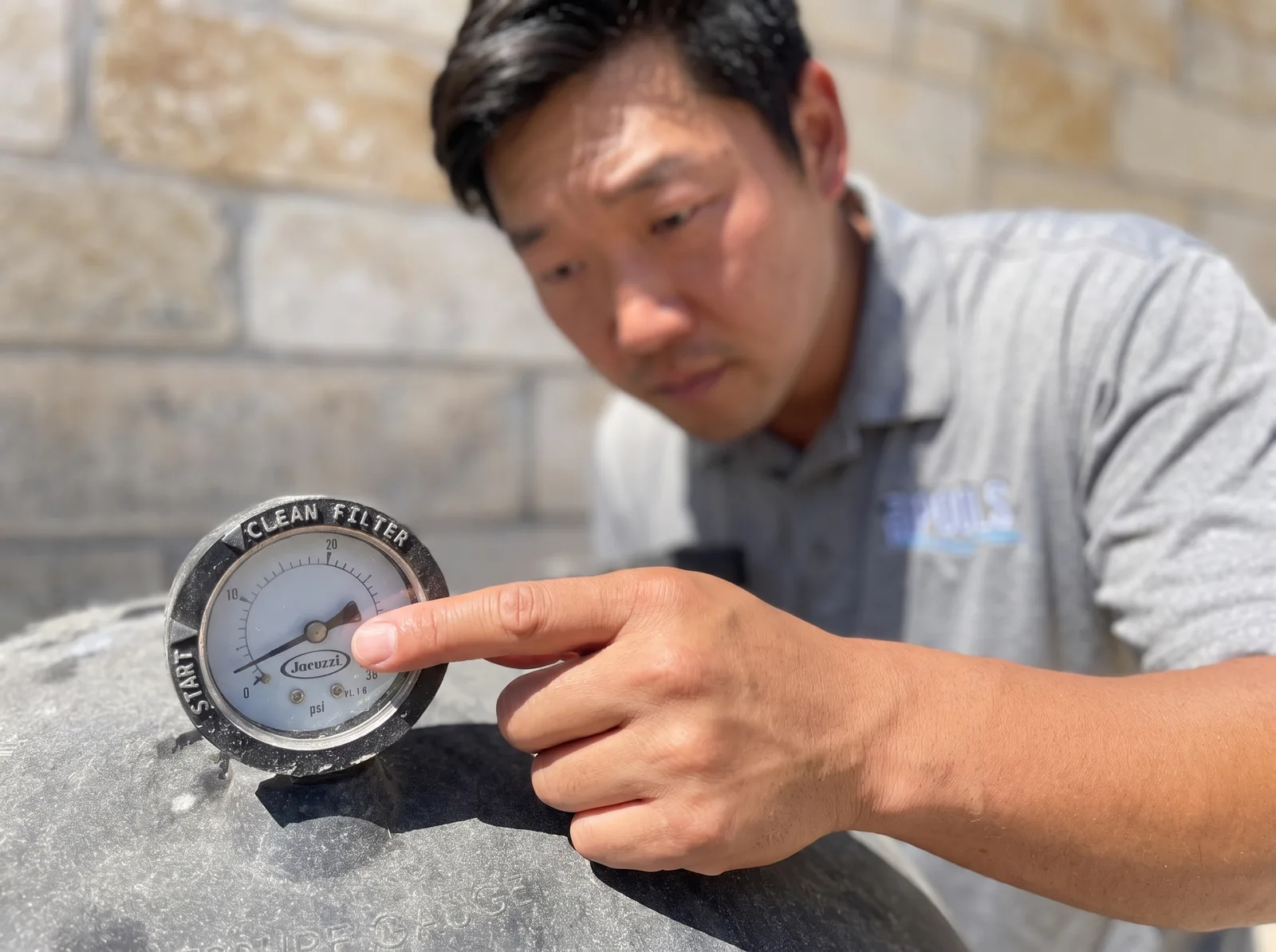
A proper diagnosis starts with an on-site inspection rather than a phone-quoted guess. That means physically checking pressure readings, listening to how a pump actually sounds under load, testing water chemistry rather than assuming it is fine, and tracing plumbing runs where a leak is suspected rather than assuming the most visible symptom points directly at the cause.
Once the actual failure point is identified, a clear, specific explanation of what is wrong and why should come before any work starts, not after. That sequence, diagnose first, explain clearly, then fix, is what keeps a repair from turning into an open-ended, ever-expanding invoice, and it is the standard every repair call should be held to regardless of who is doing the work.
Pumps, Filters, Heaters: What Actually Fails and Why
Pumps fail primarily from mechanical wear (bearings, seals, and impellers all have a finite service life), from electrical faults (capacitors and control boards on newer variable-speed units), and from being run dry or against a blocked line, which stresses components that were never designed for that load. A pump that is making a new noise, running hot to the touch, or losing prime repeatedly is usually signaling one of these three categories well before it fails outright.
Filters, whether cartridge, sand, or DE, fail more often from neglect than from a manufacturing defect: a cartridge that never gets properly cleaned accumulates oils and fine debris until it simply cannot flow water efficiently anymore, and a sand or DE filter with degraded media stops filtering to spec even though water is still visibly moving through it. Filter problems tend to show up as symptoms elsewhere, cloudy water, a pump working harder than it should, rather than as an obvious failure at the filter itself.
Heaters see a different failure pattern tied heavily to water chemistry: scale buildup from hard water is the single biggest cause of reduced heater efficiency and eventual failure, since scale insulates the heat exchanger and forces the unit to work harder to reach the same temperature. This is exactly why hardness tracking during routine maintenance matters for heater longevity, not just for chlorine and pH.
Leak Detection: What It Actually Involves
The most reliable sign of an actual leak, as opposed to normal evaporation, is a water level drop that clearly exceeds what heat and evaporation alone would explain, typically more than roughly a quarter to half an inch of water loss per week during Central Texas summer conditions. Other signals include a pump that keeps losing prime, visible air in the return jets, unexplained wet or soft ground near the equipment pad or the pool shell itself, and chemical demand that never seems to stabilize no matter how carefully the water is balanced.
Isolating where a leak is actually coming from, the shell, the plumbing, or the equipment, is the core skill in leak detection, and guessing wrong here is exactly how a repair ends up costing more than it should. A dye test at a suspected crack, a pressure test on suspect plumbing runs, and a careful visual inspection of every equipment connection are the standard tools for narrowing down the actual source before recommending a fix.
Once the source is identified, the fix itself is usually far more contained than homeowners expect going in, a specific fitting, a specific crack, a specific valve, rather than a wholesale plumbing overhaul. The diagnosis is genuinely the hard part; the repair that follows a correct diagnosis is usually the straightforward part.
Homeowners sometimes delay a leak call because the water loss seems minor at first, a fraction of an inch here or there does not sound dramatic. But a small leak rarely stays small once water finds a path through soil, decking, or plumbing insulation, and the cost of a delayed leak repair is almost always higher than the cost of the leak detection visit itself would have been. Treating a suspected leak as worth checking promptly, rather than waiting to see if it gets worse, is consistently the more cost-effective choice.
Same-Week Repair Service Across the Austin Metro
Most repair calls across the Max Pools Austin service area, Austin, Westlake Hills, Bee Cave, Lakeway, Dripping Springs, Spicewood, Driftwood, Buda, and Round Rock, get an on-site inspection the same day or the next business day. Because the client roster stays deliberately small, repair scheduling is not backed up the way it often is at larger operations juggling a much bigger book of business across a wider area.
Repair needs vary meaningfully by area. Older, mixed-vintage neighborhoods closer to central Austin and in parts of Round Rock more often produce repairs tied to aging, mismatched equipment installed piecemeal over the years. Newer growth corridors like Buda and parts of Round Rock skew toward warranty-relevant issues on still-fairly-new builder-grade systems. Well-water communities including Dripping Springs, Spicewood, and Driftwood see a disproportionate share of hardness-driven repairs, scaled heaters, worn salt cells, since that mineral-heavy water accelerates a specific category of wear that municipal-water areas see far less often.
Regardless of which part of the service area a call comes from, the same diagnosis-first standard applies: identify the actual failure point, explain it clearly, and only then recommend a fix. The team is certified across Fluidra, Hayward, Jandy, Waterway, and Zodiac equipment plus National Pool Tile products, which covers the large majority of what shows up across this range of pool ages and equipment generations.
That certification breadth matters practically, not just as a marketing point. Jandy, Zodiac, and Fluidra are the same manufacturer sold under different names, so certification across that family alone covers a wide share of installed equipment across the metro, while Hayward and Waterway certification rounds out coverage for the other common brands homeowners across this area are likely to already have installed. A repair technician who is only comfortable with one or two brands ends up guessing on everything else, which is exactly the situation a proper diagnosis-first approach is meant to avoid.
One playbook does not fit every Austin pool
Austin carries the widest range of pool ages and pool types of any area on the route. Central neighborhoods hold plaster pools that are decades old, built long before today’s variable-speed pumps and salt systems existed, alongside newer backyard renovations that layered modern equipment on top of an old shell. Farther out toward the growth corridors, subdivisions from the last fifteen years carry gunite and fiberglass pools built to a more standardized spec. Servicing Austin means adjusting the approach pool by pool rather than assuming one playbook fits the whole city, and it means the crew has seen close to every equipment combination the metro has to offer.
Pool ownership across Austin
An older plaster pool in a central Austin neighborhood behaves differently than a five-year-old build in a suburban subdivision. Aging plaster etches and stains in ways that change chemical demand month to month, and older pools are more likely to be running equipment that has been patched and replaced piecemeal over the years rather than installed as a matched system. That history matters when diagnosing a repair, since a pump replaced in 2019 next to a filter from 2011 does not always talk to the same automation the way a fully matched system would.
Newer Austin builds tend to run tighter automation, energy-efficient variable-speed pumps, and salt chlorination as the default rather than the exception. These systems are generally lower-maintenance week to week, but when something does go wrong, the fix usually involves a specific board, sensor, or cell rather than a simple mechanical part. Recognizing which category a pool falls into on the first visit shapes both the maintenance plan and the repair approach from day one.
Central Austin also has more homes where a pool has changed hands with the property, sometimes more than once, and where the equipment history is not fully known by the current owner. Part of the first visit to any new client’s pool in Austin is building that history back up: reading serial numbers, checking install dates where visible, and noting anything that looks like a past patch job rather than a proper repair. That record becomes the baseline for every visit after it.
Backyard size and layout also vary more in Austin than in most newer suburbs, since older neighborhoods were platted before pools were a default expectation and additions were fit into whatever space was left. A pool wedged into a smaller central Austin lot sometimes has less room around the equipment pad than a standard subdivision setup, which is factored into how a visit is planned, especially for anything involving parts replacement rather than routine chemistry work.
Weather and water chemistry in an Austin summer
Austin summers run long and hot, often with stretches of consecutive 100-degree days from June through September. Heat accelerates chlorine burn-off and algae growth, which is why a pool that looked fine on a Monday visit can show early algae bloom by Thursday if a filter is starting to lose efficiency or a chlorinator is under-dosing. Weekly maintenance is set up around this reality: water testing and balancing, skimming and brushing, and filter checks every visit rather than a lighter seasonal schedule.
Central Austin’s municipal water supply is generally softer than the well water found farther out toward the Hill Country, which simplifies some of the scale-related maintenance work but does not remove the need for consistent chlorine and pH management through the hottest months. A pool that sits untouched for even a week or two in peak summer can go from clear to green fast, which is the core argument for a standing weekly plan rather than reactive, as-needed visits.
Winters in Austin are mild but not frost-free, and a handful of freeze events most years put older, un-winterized equipment at risk. Weekly visits taper as pool use drops through the colder months, but equipment checks continue, since a cracked pump housing from an unexpected February freeze is a far more expensive fix than a preventive check the week before a cold snap.
Spring in Austin brings its own chemistry challenge: pollen season coats pool surfaces in a fine yellow film for several weeks each year, which changes filter demand even before the real summer heat arrives. Accounting for that seasonal swing, rather than running the exact same routine year-round, is part of what keeps a pool from falling out of balance during the shoulder seasons.
Weekly maintenance in Austin
Weekly maintenance plans in Austin are priced depending on pool size and equipment, and cover water testing and balancing, skimming and brushing, filter checks, and equipment inspection on every visit. The goal on each stop is the same regardless of neighborhood: leave the water balanced and leave a clear record of anything that needs attention before it becomes a repair call. For older pools with more equipment quirks, that inspection step often catches small issues, a slow leak at a union, a pump starting to run loud, before they turn into an emergency.
Because Austin properties vary so much in age and layout, the first month of service on a new Austin account usually involves a bit more note-taking than a straightforward newer-subdivision pool elsewhere on the route. That upfront work pays off; once the pool’s quirks are documented, every following visit runs faster and catches problems sooner.
Austin’s density also means a maintenance route through the city touches more neighborhoods in a single day than a similar route through a spread-out Hill Country town, which keeps the weekly schedule efficient without cutting the actual time spent at each pool. Every stop still gets the same full routine regardless of how tight the day’s route is.
Repairs across Austin’s pool inventory
Repair work in Austin spans the full range from decades-old plaster pools running mismatched equipment to newer builds with variable-speed pumps and salt systems still under warranty. Most repair calls get an on-site inspection the same day or the next business day, and the crew is certified on Fluidra, Hayward, Jandy, Waterway, and Zodiac equipment, which covers the large majority of what shows up across Austin’s pool stock regardless of the home’s age. Leak detection, pump and filter repair, tile and plaster work, and equipment diagnosis are handled with the same diagnosis-first approach: identify the actual failure point before recommending a fix, rather than defaulting to a full equipment swap.
On older Austin pools, a repair call sometimes turns up more than one issue at once, since equipment that has never been serviced together tends to fail out of sync. In that situation the inspection covers the full system rather than just the reported symptom, and any additional findings get flagged clearly before work starts, not added as a surprise on the invoice.
Construction for existing Austin clients
New pool construction is offered only to existing maintenance clients across the Austin service area. It is referral-based and one project runs at a time, so a build gets direct oversight from Max rather than being one of several jobs a crew is juggling simultaneously. This is not a high-volume build operation; it is a smaller, second offering for homeowners who are already on the weekly maintenance route and trust the relationship enough to bring a bigger project into it.
For an Austin homeowner on a central, older lot considering a renovation rather than a full new build, the same one-project-at-a-time approach applies. Renovations on established Austin pools sometimes involve more unknowns than a clean-slate new build, whatever the original construction and past repairs left behind, and the referral-only structure means that discovery process happens with the same person who already knows the pool from weekly service, not a crew starting from zero.
What the first visit to an Austin pool looks like
A new Austin account starts with a full walk of the equipment pad before any chemistry work begins: pump model and age, filter type and last-known service, chlorination method, and any visible patch jobs from past repairs. That baseline gets written down so every following visit is measured against what is actually installed rather than a guess based on the home’s age or neighborhood.
The first test also checks for anything a homeowner may not have flagged directly, a slow leak at a union fitting, a pressure gauge reading outside normal range, or a salt cell nearing the end of its service life. None of that changes the quoted monthly rate, but it does mean the first visit sometimes runs longer than a standard weekly stop while that record gets built. After that, the routine settles into the standard weekly check: water testing and balancing, skimming and brushing, filter checks, and an equipment glance, with the account’s specific history already on file.
Get in touch
Across Austin’s full mix of decades-old plaster pools and newer subdivision builds, the constant is who shows up: Max personally, on every route, whether that is the first walk of an unfamiliar equipment pad or the final check on a repair. There is no dispatcher assigning your pool to whoever is nearest and no rotating crew relearning its history each visit.
If an Austin pool needs weekly attention, a repair diagnosis, or you are already a maintenance client thinking about a future build, reach out to talk through the pool and the schedule. Same-day or next-business-day inspection is standard for repair calls, and new accounts are added as the route allows, no long-term contract required to start.

GET STARTED
Work With a Pool Company That Actually Shows Up
Max Pools Austin is currently accepting new maintenance clients in the Greater Austin area. Spots are limited on purpose.
 4.6(31)
Talk to Max
We treat our customers like they are our own, with our mom-and-pop shop. When you reach out, you are talking directly to MAXWELL CONKLIN and his team. We make every effort to respond the same day.
Check your zip code
Do we service your area?

You will hear back from MAXWELL CONKLIN directly.